
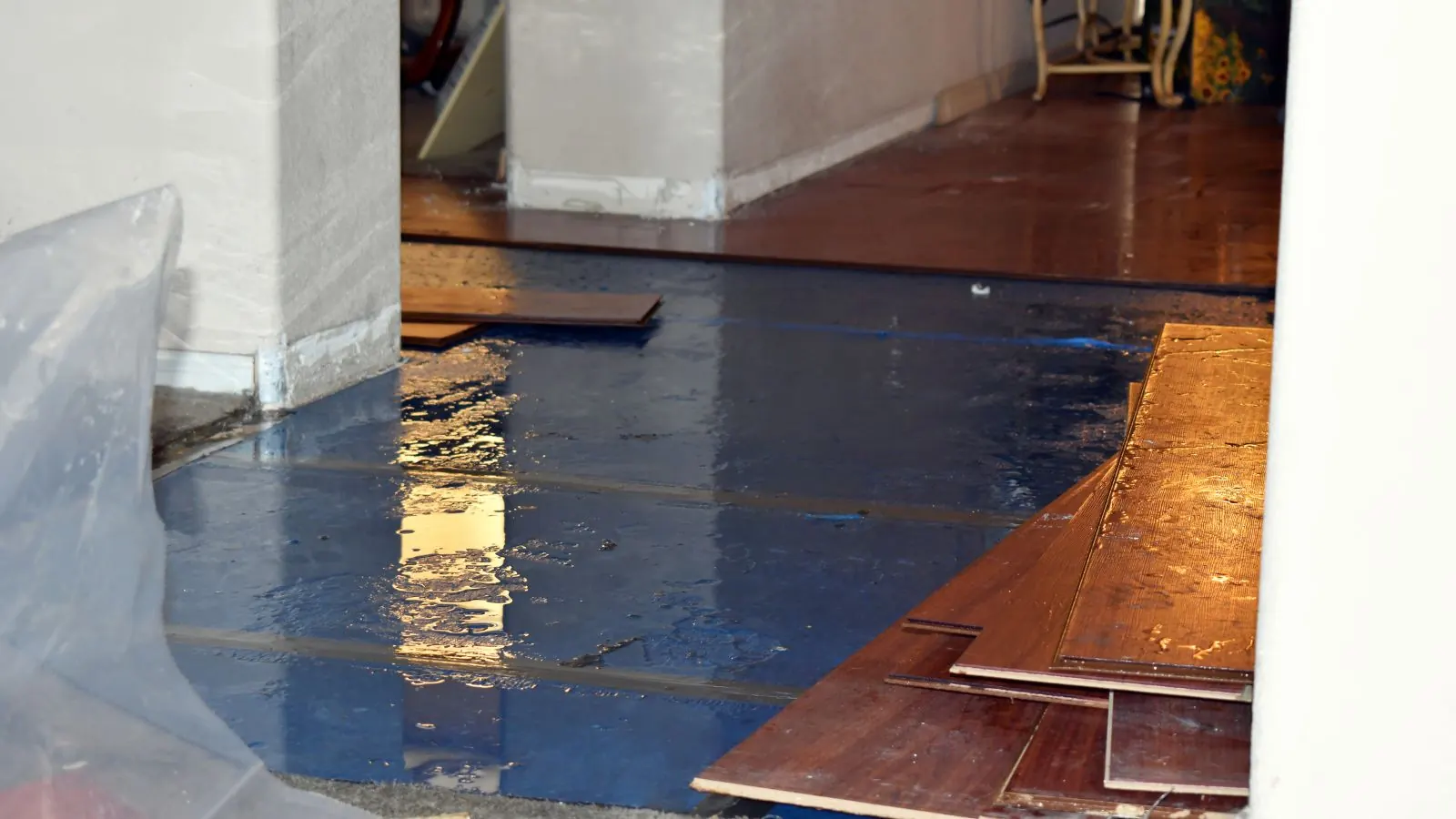
Why wet hardwood cups
Wood takes on moisture through its underside faster than through its sealed top. When a dishwasher line leaks or a slab sweats, the bottom of each plank swells while the top stays put, and the board edges curl upward into a shallow trough. That curl is cupping.
The opposite shape is crowning, with the center of a board peaking higher than its edges. It usually shows up after a cupped floor has been sanded while it was still wet. Both conditions mean the wood holds more water than it should, and neither is fixed by finish alone.
Signs the floor is reacting to moisture
- Board edges that feel raised, with a visible dip across the middle of each plank
- Gaps opening between boards after they first swelled tight
- White haze or cloudy patches in the finish
- Dark stains along seams or around nail heads
- A hollow sound or soft give when you step near a wall or fixture
- A floor that lifts off the subfloor at one end
How a wet hardwood floor gets dried
Stop the water and lift what you can
Shut off the source and remove rugs, furniture, and anything holding water against the boards. Wipe standing water with towels and run a wet vac over the surface. Never drag heavy items across a swollen floor.
Read the moisture
A moisture meter set for the wood species shows how wet the planks are, and a second reading on the subfloor shows whether water is trapped below. A thermal imaging camera helps find wet zones that the surface hides. These readings are your baseline.
Dry from above and below
Crews place air movers and LGR (low grain refrigerant) dehumidifiers, and many use floor drying mats that pull moisture through the boards. If the floor sits over a crawl space or basement, drying also happens underneath.
Hold off on heat and sanding
Cranking up the furnace or aiming a space heater at the floor dries the top too fast and can split boards. Sanding wet wood locks in the cup. Patience here is what saves the floor.
Recheck until readings flatten
Wood often relaxes back toward flat as it dries over days or weeks. A floor that still cups after readings match a dry reference needs a different plan.
Refinish or replace?
The decision rests on how deep the damage runs, not on how bad the surface looks on day one. This table covers the usual cases.
| Condition | Usual outcome | Why | Check before deciding |
|---|---|---|---|
| Mild cupping that eases as the floor dries | Sand and refinish | Wood returns close to flat and enough thickness remains for sanding | Moisture readings match a dry reference |
| Cupping that stays after full drying | Replace the worst boards or the room | Fibers have set in a curved shape | Check the subfloor for ongoing moisture |
| Crowned boards | Sand after dry, or replace | Surface was sanded before the wood finished drying | Remaining wear layer thickness |
| Buckled planks lifting off the subfloor | Replace the affected area | Fasteners and glue bonds have failed | Subfloor condition and moisture |
| Dark staining through the board | Replace the stained boards | Stain runs through the wood, not just the finish | Whether a leak is ongoing |
| Engineered floor with peeling layers | Replace | Veneer and core have separated | Product type and manufacturer thickness |
| Surface stains only, boards flat and dry | Spot repair or recoat | Damage stayed in the finish | Whether a screen and recoat blends |
Standing water or a wet wall in your home? Talk to a dispatcher now.
☎ Call (385) 988-9410Solid, engineered, and the subfloor underneath
Solid hardwood can often be sanded several times over its life, so a cupped floor that flattens may refinish well. Engineered flooring has a thin veneer over a plywood or fiberboard core. Its wear layer allows only limited sanding, and the core can swell and delaminate when wet.
The subfloor decides the outcome as often as the boards do. Plywood or oriented strand board that stays wet will keep pushing moisture up into the planks. When a crew finds a wet subfloor, repair work waits until it passes a reading and any soft or stained panels are cut out and replaced.
Sanding and refinishing done right
A refinish starts with a three-pass sand, working from coarse to fine grit with an edger for the borders. The crew vacuums, tacks the dust off, applies stain if the owner wants one, then lays two or three coats of finish with drying time between coats. Rushing coats traps solvent and causes soft spots.
Boards that were replaced need to match the old floor in species, width, and grade, then get blended at the seams with the surrounding finish. Matching the sheen over a whole room often means refinishing wall to wall instead of patching one corner.
Mistakes that cost homeowners their floor
Sealing it in
Covering wet boards with a rug, new finish, or plastic locks moisture in and speeds mold growth under the covering.
Sanding early
A floor sanded while wet will crown as it dries, which means a second sanding or replacement.
Guessing by eye
A floor that looks flat on top can still read wet underneath, so meter readings matter more than appearance.
Skipping the source
A slow fixture leak, appliance line, or damp slab will cup the next floor too if nobody traces it.
What to document for repairs and claims
Photograph the floor in raking light, with a lamp low to the surface, so the cup shows in the image. Record the room, the plank width, and the species if you know it. Keep the installer invoice or product details, since they help a contractor match the replacement.
Save moisture readings from before and after drying and keep any board pieces that were removed. These records help an adjuster see whether the damage came from a sudden event or a slow leak, which affects coverage. Ask your insurer what it wants to see.
When floor repair needs a professional
Call when water has covered more than a few square feet, when boards are buckling, or when the floor sits over a finished basement ceiling. Fast water mitigation is what keeps a floor that can be saved from becoming a floor that cannot. Once it is dry, water damage repair covers the sanding, board replacement, and finish.
Our dispatch also reaches homes in Pleasant Grove and American Fork, where older homes with original oak or maple floors face the same decisions. We answer 24/7, and while you wait you can lift rugs and wipe the surface.
Drying targets and the order of work for wet flooring follow ANSI/IICRC S500, the published standard for water damage restoration. It is worth asking any company you hire whether its crews work to it, and what drying readings they will show you.
What Orem homeowners should know
Orem incorporated in 1919, largely to build a water system, which makes the city's water service old civic infrastructure. Homes connected decades ago may still have original service lines and supply plumbing that has aged too. If a floor is wet from a slow leak, ask a plumber about the age and material of the line that feeds the room.
Utah Valley University draws a large share of Orem's renters, and rental floors are where leaks often go unreported until boards cup. Tenants should send written notice and photos, and landlords should document the cause and drying readings. A dated paper trail makes it much easier to decide who pays for repairs.
Source types: Utah State History Encyclopedia, Utah Valley UniversityFrequently asked questions
Sometimes. If the wood was only mildly wet and is dried carefully, cupping can ease over days or weeks as moisture leaves. Floors that stay cupped after readings return to normal usually need sanding or board replacement.
As soon as the source is stopped. The longer boards stay wet, the more they swell and the more likely finish and stain damage becomes. Even simple steps like wiping, lifting rugs, and calling for drying equipment help.
A fan helps a very small spill. A space heater is risky because rapid drying from above can split boards and leave the underside wet. Professional drying matches airflow and humidity to the floor type.
Usually harder. The thin veneer and layered core can swell and separate when saturated, and those layers do not recover once they delaminate. Solid planks tolerate more water and have more thickness left to sand.
Surface stains in the finish often sand out. Dark stains that run through the board do not, and those boards are usually replaced. A contractor can tell the difference by testing a small area.
Not always. Damaged boards can be cut out and replaced, then blended into the surrounding floor. Because stain and sheen differ across a room, many owners choose to refinish the whole space after patching.
Tell the landlord or property manager in writing right away, photograph the damage, and keep copies of every message. Call our 24/7 line if the water is spreading. The property owner usually decides on repairs, so keep your own record for any dispute about cause.